
Introduction
This document is intended to provide information on the role of a Visually Impaired (VI) Archer’s spotter in tournaments. It is not a training course for spotters and should not be treated as such. For that a formal “Spotters Course” should be undertaken or equivalent training provided by the archer’s Club.
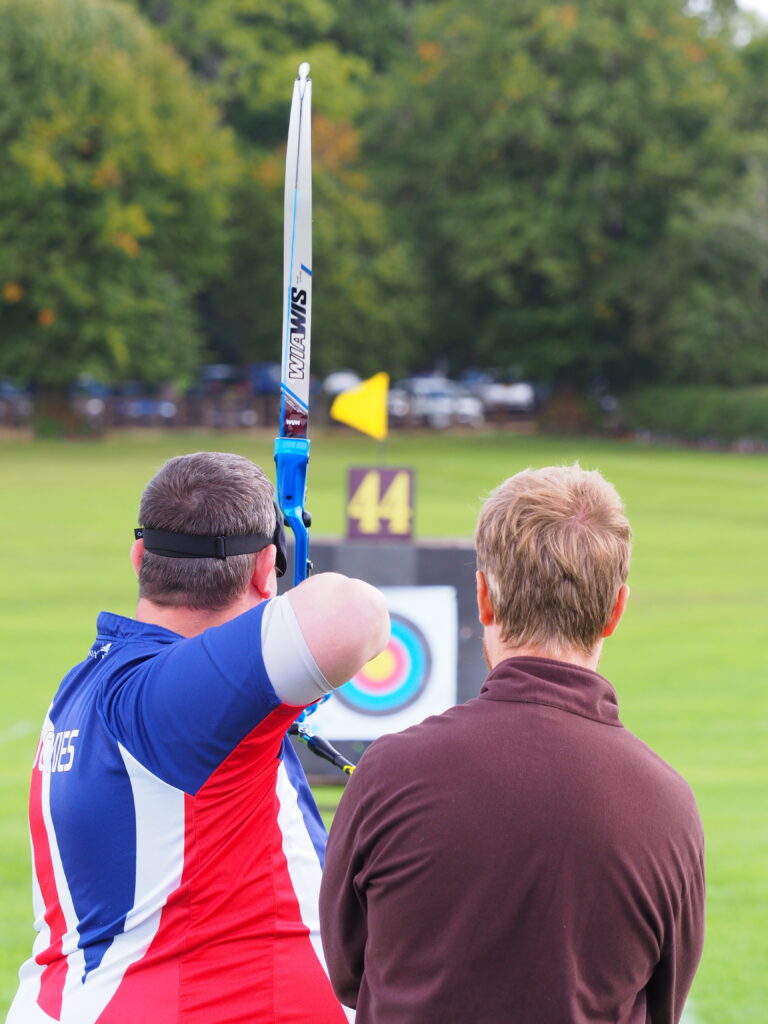
Spotters Role
The role of the spotter is to fulfil a number of functions.
The main one is:-
- Provide safety and any other important information to the archer that they might not otherwise be aware of.
- This extends to contributing to ensuring the safety of everyone present.
Other functions are:
- Provide information on the fall of each arrow to the archer during shooting.
- Provide assistance to the archer with their equipment (when allowed).
- Represent the archer. Sometimes it is more practical if the archer is not present when their arrows are scored and in this situation the spotter will represent the archer.
Organisations
A number of organisations will be referred to in this document.
- British Blind Sport (BBS)
- The main organisation for Visually Impaired sport in the UK
- British Blind Sport – Archery Section (BBS Archery Section)
- A Sports Section of BBS for VI archery in the UK.
- World Archery (WA)
- The world governing body for both “able bodied” and “para” archery.
- Archery GB (AGB) / Grand National Archery Society
- The UK governing body and the only UK body recognised by World Archery. Archery GB is the trading name of the Grand National Archery Society.
- This document may refer to Archery GB’s Rules of Shooting which may be abbreviated to AGB RoS and Shooting Administrative Procedures, abbreviated to AGB SAPs.
Informal Summary of Rules for Spotters
This document is not a set of rules as these are covered elsewhere.
Specifically:-
- World Archery – Rules
- Archery GB – Rules of Shooting and Shooting Administrative Procedures.
These documents should be consulted for the formal rules but the following can be treated as an informal summary.
- The spotter is responsible for checking and informing the VI archer of safety issues.
- The spotter can assist the VI archer to set up the sighting aid by adjusting it in any way when scoring arrows are not being shot. The spotter may also assist the archer with the tactile sight when arrows are being collected.
However, the spotter must not adjust the tactile sight between the whistle to start the scoring end of arrows and the whistle to collect those arrows. Therefore the archer must adjust their own sighting devices during ends of scoring arrows (between the whistles).
Please note that the term “whistle” is used to in this document to describe whatever sounding device or command is used to start and stop shooting. - When making adjustments neither the archer or spotter may cross the shooting line (take both feet in front of it) until the whistles to collect arrows are blown. If archer or spotter can’t reach to make adjustments then they have to wait.
- Once the scoring arrows have begun, the spotter may only pass on:
- Information required for safety.
- Timing information.
- The fall of each arrow. This is covered later in “communicating with your Archer”
- The spotter must not coach or give any advice on shooting whilst the archeris shooting an end of scoring arrows (between the whistles).
- The spotter must stand between the shooting line and the waiting line. At some events a spotter’s line is marked and the spotter is required to stand just behind this. This line will be 3 feet (1 metre) behind the shooting line. At some events the spotter may be required to sit at this position.
- When the archer has completed their scoring end, the spotter, with or without the archer, must stand behind the waiting line. The archer may either, keep the bow but place it on a stand, carry the bow with them behind the waiting line, or pass the bow to the spotter for the spotter to take with them behind the waiting line leaving the archer on the shooting line. This will indicate to the judge that the archer has completed the end.
- Spotters are regarded by Archery GB as “assistants”.
Spotters Responsibilities
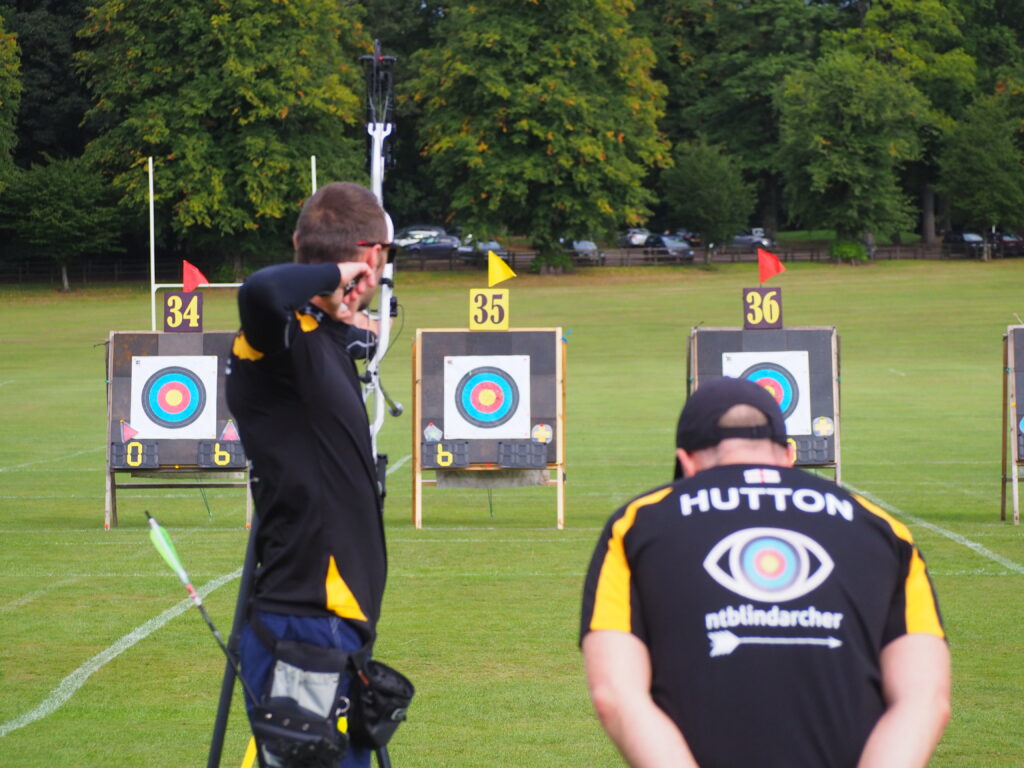
Remember, you are responsible for the archers’ safety.
- Ensure the archer follows any directions given by the judge.
- Ensure that the archers do not approach the target straight on but to one side so as not to walk or risk tripping into the arrows.
- Make sure the archers do not stand behind the person who is pulling the arrows from the target.
- Make sure that the archer (and you) don’t walk into or trip over any other archer’s equipment.
Spotters are regarded by Archery GB as “assistants” and are therefore covered under the insurance whilst on an archery range as long as Archery GB’s rules are followed.
The spotter can also represent the archer at the target for scoring purposes etc..
Communicating with Your Archer
One of the rules of etiquette of archery is that “A Good Archer: Does not talk in a loud voice whilst others are shooting”. This is not only the etiquette but also a matter of safety. A loud exclamation could startle another archer causing their arrow to shoot widely. Therefore all talking, wherever it is on the range, must be kept at the lowest possible level.
There are two situations to consider once the competition has started.
The first is while you are up on the shooting line.
- During “sighters” there are no limits on what you can tell your archer.
- Once the scoring arrows have begun, the spotter may only relate the fall of each arrow and provide safety and timing information. Nothing else.
- The fall of the arrow is usually called using the face colour and a “clock position” i.e. red 2 o’clock blue 5 o’clock etc.
- The spotter can state the archer’s name before relating the strike of the arrow if necessary to avoid confusion with other archers.
- Other descriptive methods of communicating the fall of the arrow can be agreed between archer and spotter.
- All talking on the shooting must be done in a quiet manner so as not to disturb fellow archers on the shooting line.
- When the archer has a hearing impairment, the spotter may step forward to a closer proximity to the archer so that they can relate the strike of the arrow. The spotter must then immediately move back to the spotter’s line until the strike of the next arrow, and so on.
The second situation is when you are away from the shooting line. However, please wait until you and the archer are both behind the equipment/waiting line before you start any conversation and then please keep your voices low to avoid disturbing other archers who may still be shooting. It is only natural to want to start talking as soon as possible but please wait until you are away from the archers still shooting.
If the archer is staying on the shooting line once they have shot their arrows (as is allowed under certain conditions) then the spotter should still retire behind the equipment/waiting line to show the judges that that archer has finished shooting. The spotter will then have to wait until the whistle is blown for collection before approaching the archer and having any conversation.
Before Shooting
Dress Code
As stated previously, a spotter is treated as an “assistant” and is therefore technically not covered by the dress regulations for archers. However, the rule “Footwear that fully encloses the toes and front of the foot must be worn at all times when shooting” should be followed.
The other rules that apply to archers include “Tops or shirts must cover the front and back of the body (including the midriff when at full draw), they must not be strapless and, for gentlemen, must include sleeves” and “Any colour garments may be worn with the exception of blue denim, olive drab and camouflage pattern”.
Getting There
Make sure that you know where you are going and try to arrive early. It takes a lot longer to set up for a visually impaired archer than it does for a sighted archer so you want to give yourself time. You also don’t want to be having to walk to the second or even third row of tents so the earlier you arrive the more likely you can place your tent at the front.
Assembly
Assembly is called at the beginning of a tournament. This is where the various officials and dignitaries are introduced.
The senior judge and tournament organiser will also run through the rules that will be used. Note that the general rules (Archery GB, World Archery etc) that will be used will be stated on the flyer/entry form. Therefore you have the opportunity to read up on them before going to the event.
It is usual for a judge at a non-VI specific tournament to seek out VI archers and talk to them about the VI aspects of the rules. However if they haven’t then immediately after assembly is the time to ask any questions you may have. It is much better to check than get it wrong later. Remember that there are not that many competitive VI archers at present so the judge(s) may not be that familiar with the VI specific rules.
Check out the rules on the day; listen to the officials opening remarks.
If in doubt, check the rules with the official/judge of the competition as these may change.
When Shooting
Sighters/Practice
An archer is allowed to shoot a number of arrows before scoring begins. For Archer GB rules this is known as “sighters”. For World Archery this is known as “practice”. It is important to differentiae between the two terms as the rules are different.
Archery GB rules – ‘Sighters’
For sighers only the same number of arrows as in a scoring end may be shot per end of sighters, with a total of around 6 arrows. So, for most indoor rounds there are two ends of 3 ‘sighers’. For most outdoor rounds there is one end of 6 ‘sighters’.
One aspect of the VI specific rules is that it allows for VI archers using tactile sights, to have an additional end of sighters at the initial distance (AGB RoS 1107 B i) unless they opt not to. Sighted archers and VI archers using a bow-sight are only allowed one end of sighters.
In addition, at each change of distance, VI archers using a tactile sight are allowed an additional end of sighters unless they opt not to (AGB RoS 1107 B ii). Again sighted archers and VI archers using a bow-sight are not allowed these additional sighters.
Discuss this with the judge before the tournament starts if the archer is unsure.
Please note that a change of face size for the “Burntwood” type rounds is NOT a change of distance and therefore the archer should not take additional sighters even if they are offered them. The centre of the new face will be placed in exactly the same position as the old face so the archers aiming point does not need to alter. If the archer claims a National Record and it is discovered that they took additional sighters for these rounds, your record will be invalidated.
World Archery rules – ‘Practice’
Rather than a fixed number of ends of practice, it is defined as a period of 45 minutes and as many ends as can be fitted into that period are allowed. Often though it will be stated that a minimum of two ends will be shot. In addition, the ends are timed, and the archer can shoot as many arrows as they like during allotted time. It is important to ensure that the archer only shoots the allowed number of arrows once scoring begins. If they shoot too many arrows, their highest scoring arrows will be discounted to reduce the total number of arrows to the correct value.
Guiding Archers to the Target
It is quite common to guide archers to the side of the target and let them touch the side to get a reference. This should be acceptable but please talk to the judges before the competition starts to check that they are happy about this. The reason is that technically, touching the target before the arrows are scored is against the rules. What defines “touching the target” is vaguely worded so it is best to check beforehand.
Please also note that if a VI archer is using a spotter, then by AGB rules they cannot approach the target without their spotter (AGB RoS 1107 B vii).
Information on Scoring etc.
A spotter will be required to score for the VI archer. This will involve either calling the scores to the scorer or possibly acting as scorer. If acting as scorer then another spotter or sighted archer is required to call your archer’s scores.
A “target captain”, who is nominally the third archer on the target list for that target, takes responsibility for the scoring. However, in reality, who takes this responsibility is often decided by mutual agreement.
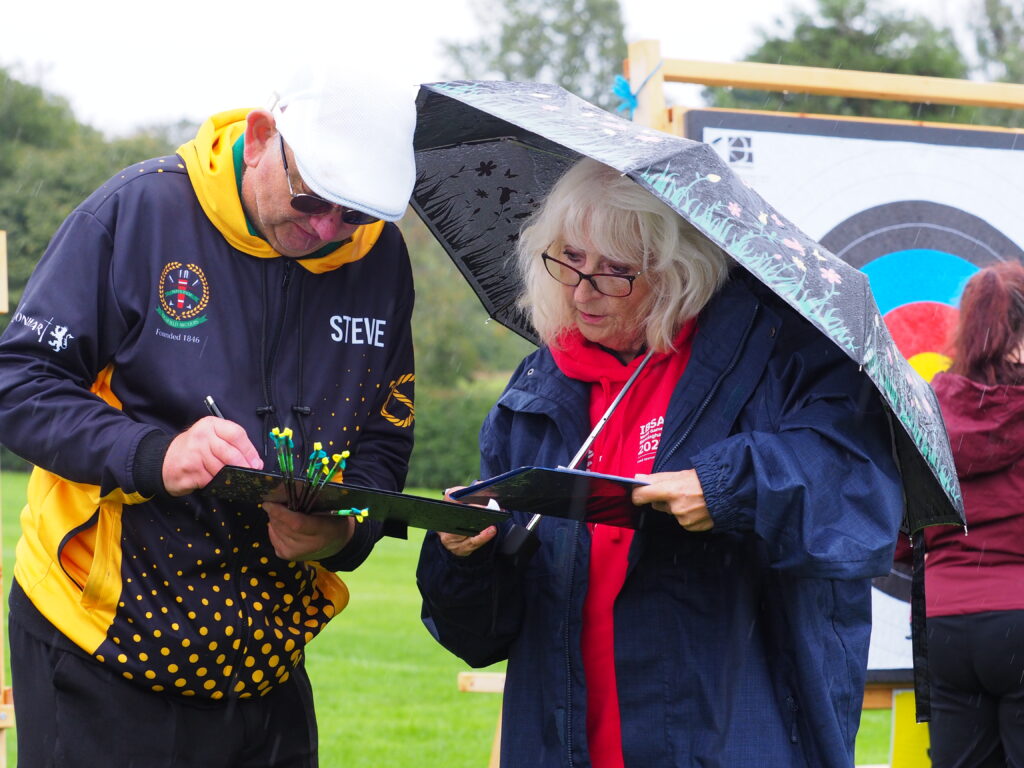
Note that at the target the spotter is representing the archer and is not a separate individual.
Therefore:
- If the archer accompanies the spotter to the target then the archer must leave the calling to the spotter.
- The spotter cannot act as witness for the archer’s score, they are effectively the archer and an independent witness is required.
Please also note that if a VI archer is using a spotter, then by AGB rules they cannot approach the target without their spotter (AGB RoS 1107 B vii).
5 or 10 Zone Scoring
Scoring can either be 5 or 10 zone depending on the round being shot. Generally 5 zone scoring is used where the distances are measured in yards and 10 zone scoring where the distances are measured in metres. The main exception is the Archery GB Portsmouth round which uses 10 zone scoring at 20yards but if in doubt for any round please ask the Judge.
From the centre the two methods are scored:-
- 5-zone scoring (Archery GB “imperial” Rounds)
- gold – 9,
- red – 7,
- blue – 5,
- black – 3,
- and white – 1.
- 10 zone scoring (Archery GB “metric” and Portsmouth Rounds and World Archery Rounds)
- gold inner inner ring – X or 10 (see later)
- gold inner/middle ring – 10 (also see later)
- gold outer ring – 9
- red inner ring – 8
- red outer ring – 7
- blue inner ring – 6
- blue outer ring – 5
- black inner ring – 4
- black outer ring – 3
- white inner ring – 2
- and white outer ring – 1
- In all cases all other arrows are a miss. Misses are marked on the scoring sheet as “M” rather than “0” to avoid possible confusion with “10”.
- The inner inner gold may not always be present on the target face. If it is present then it only has any significance for indoor rounds.
- Compound bows.
- For the WA VI indoor round the outer gold ring is 9 and both the middle (if present) and inner ring score 10.
- For other indoor rounds a compound archer is required to score in the inner inner gold to score 10 for rounds. The middle (if present) and outer of the 3 gold rings will score 9 for compound bows for these rounds.
- Other bow types may be required to mark arrows in the inner inner gold as an “X”. This will score 10 so is no different to the middle gold ring but the number of “X”’s scored may be used to determine places at the end of a competition.
- Compound bows.

Calling and Recording the Scores
The following explains the procedure for calling scores. It may seem a bit long winded but it is actually there to prevent either you or your archer from being accused of cheating.
- Do not touch the arrows or target face until all arrows from all archers on that target are scored and agreed and ensure the archer does the same.
- The scores are called in groups of 3, starting with the highest scoring arrows.
- The archer/spotter will call the first group of 3 arrows and then should wait for the scorer to read them back from the score sheet. e.g. 10-9-9
- The archer/spotter points to the nock of each arrow as they call its score, taking care not to actually touch the arrow as this could move it and tear the paper further, leading to accusations of cheating.
- If agreed then the archer/spotter calls the second set of 3 scores and again the scorer reads them back before continuing to the next archer on the sheet/card.
- All the arrows shot must be called even if 6 misses which will be called as “miss”, “miss, “miss”, followed by “miss”, “miss, “miss” after waiting for the scorer to repeat the first 3 back. Do not call “6 misses” as this could be interpreted as “6, miss, miss etc.”.
- A spotter (and the same for a sighted archer) may not both call and record (write) a set of scores regardless of which archer this is for.
- If there are only two archers then one spotter may call both sets of scores whilst the other spotter records them all. Alternatively, spotter A calls archer A’s scores while spotter B records them before passing the score sheet/card to spotter A to record archer B’s scores as called by spotter B.
- Remember that the spotter acts as the archer’s representative at the target. Therefore if the archer is also present then only one of the two may call or record the arrows because as far as the rules are concerned they are the same person.
- If the arrow has cut the line, the highest score counts.
- If you are unable to agree a score then call the judge.
- If a mistake arises in recording the scores (but not in the adding up) on the score sheet/card then call the judge.
- Only a judge may alter the arrow scores.
- Do not touch the arrows or target face prior to the judge arriving.
- At the end of the shoot, the archer must sign their score sheet/card.
- Score cards that have had scores (but not adding up) that has been altered but not signed by the judge will be disqualified.
- See “Completing Score Sheets” below.
- At the end of the shoot, etiquette also dictates that you thank your fellow archer/spotter.
“Marking Faces”
For “World Archery” and some other rounds, the officials will ask that the target faces are marked. This is a method of determining if a “bouncer” or “pass-through” has actually occurred. The idea is that the target face is marked to show every arrow and therefore, when an archer claims a “bouncer” or “pass-through” the Judge can check the target face. If a “bouncer” has occurred all the holes should be marked or still have an arrow in it. If there is an empty, unmarked hole then this is where the arrow bounced from or passed-through.
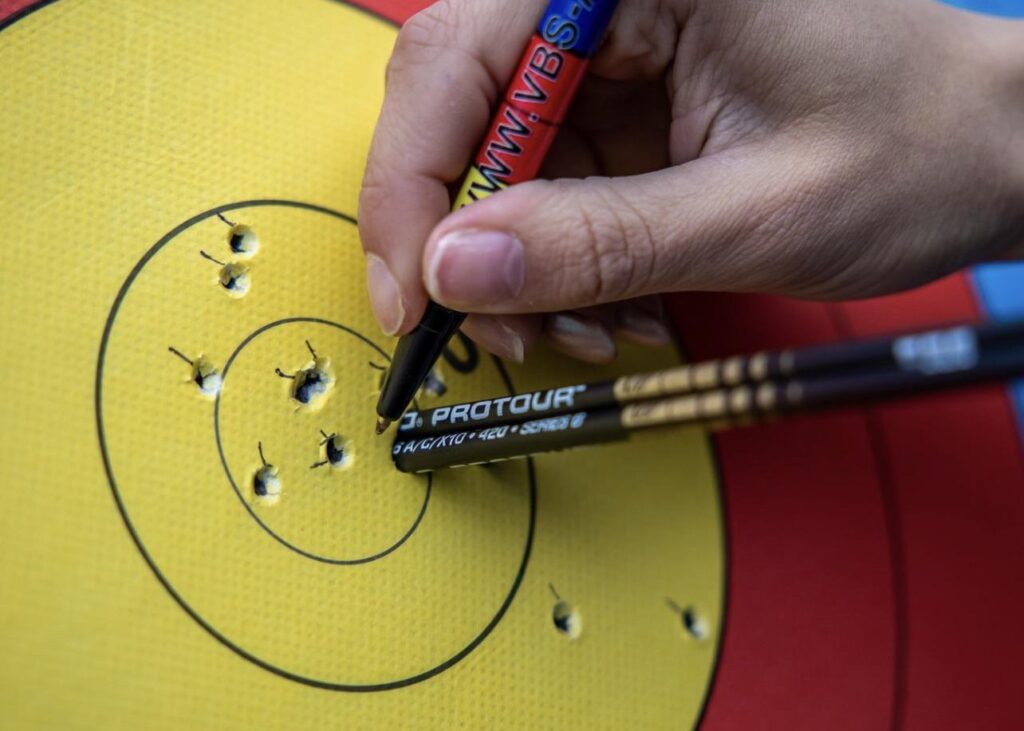
Therefore the arrow holes must be clearly marked. This is done after all scores are recorded (no arrow or the target face may be touched before this).
The marking is done with two lines. One line is vertical, touching the 12o’clock of the arrow. The other line is horizontal, touching either the 9o’clock or 3o’clock of the arrow.
Picking up non-scoring Arrows
Arrows falling short of the target (or having bounced from it) should be picked up on the way to the target for safety.
Arrows that have overshot or gone past the target should be left until ALL arrows in the target have been correctly recorded (See “Scoring”). Only then should an archer or their spotter walk behind the target to find “stray” arrows.
Completing the Score Sheet
Adding Up
Whilst the procedures described above ensure that the scores are recorded correctly (involving the Judge if necessary), the addition is up to the archer/spotter/scorer.
There will be a number of things to add up.
- The total number of hits which is the number of scoring arrows that the archer had.
- For an Archery GB round, the total number of “golds” may be required for the score sheet. For World Archery rounds it may be that “10’s” and/or “X’s” are required. It is usually the number of times the archer has scored maximum points with an arrow. For World Archery/metric rounds sometimes “10’s plus X’s” (i.e. maximum scoring arrows) is required in one column and “X’s” only in another but check if not sure.
- The total score.
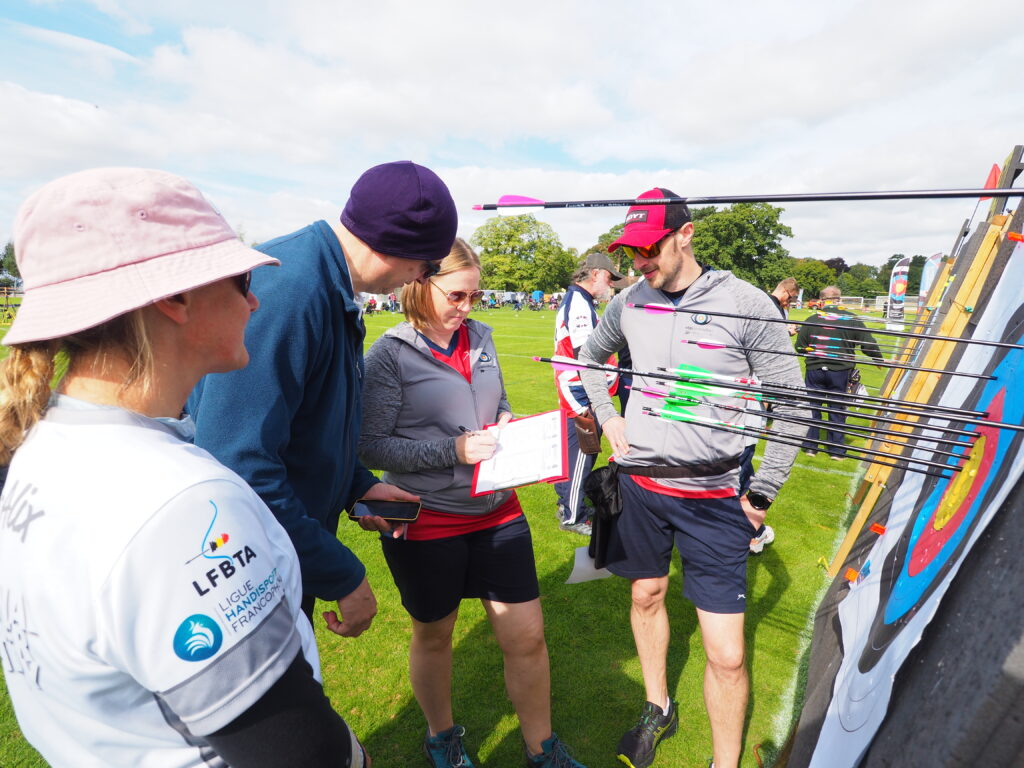
Normally there is space on the score sheet for the number of hits, number of “golds” (“10’s” etc) and score for each dozen arrows. On most score sheets there is also space to add up the dozen totals for each distance (or target face). At the end of the shoot it is then possible to add up these “distance” totals. Adding the dozen scores to produce “distance scores” and then adding these to produce an overall total can be a useful check and is worth taking advantage of.
Signing the Score Sheet
When this addition is complete on the official score sheet the archer is usually required to sign it. In doing so they are signing to state that their score (and adding up) is correct. Although the Archery GB rules aren’t explicit in how to deal with errors in the addition, the following are usually applied.
- If the submitted and signed for total score is lower than it should be then the lower (signed for) score is taken and will stand.
- If the submitted and signed for total score is higher than it should be, then this is taken as a form of cheating and the archer is disqualified and their score void.
Therefore it can be seen that it is important that the archer (and/or spotter) checks the score that is being signed for. The easiest way of doing this is to either keep a separate copy of the score, add it up independently and compare it with the official score sheet, or to check the official score sheet periodically. Actually checking the official score sheet rather than just comparing scores may give the appearance that the scorer isn’t trusted so should be done with care.
If keeping an independent copy of the score then there are a few points to note.
- Ensure that doing so does not interfere with the official score recording procedure. For example, if using a Dictaphone do not talk into it while scores are being called.
- Ensure that you still comply with the proper scoring procedure described in “Scoring” above. As most archers quickly fill in their personal score pads as soon as they arrive at the target it is very tempting to just read back from the personal score pad rather than pointing to the arrows and calling them properly.
It is unwise to let the archer sign the official score sheet until they are happy that the score on it is correct. If the archer or spotter have any doubts then they should be sorted out before the score sheet is signed. Remember, once the score sheet is signed, that is the official score that is submitted and it will be hard to go back on.
National Records
VI Archery National Records are now maintained by both Archery GB and BBS Archery Section.
The BBS Archery Section will accept records from all VI shooting classes at any event that has a least one round occurring on that range is registered with Archery GB as a Record Status event. Therefore, the round that the VI archer is shooting does not need to be Record Status, but another round must be.
It is the archer’s responsibility to claim for any BBS Archery records, even at BBS Archery events. Records must be claimed and then ratified by the BBS Archery Records Office before they are official. See the Records page for more information.
Archery GB will also accept VI record claims but only from archers shooting in Record Status tournaments. The archer must also be in one of the World Archery defined divisions (VI 1 or VI 2/3) and their equipment must meet World Archery rules. The procedures are outlined in Archery GB’s Shooting Administrative Procedure 5. AGB keep records for VI archers for the following rounds. Please note that in the list below the first name is from AGB RoS and where there is a second name it is from the WA rules Book 3. The rounds are the same.
- WA VI Indoor/VI Indoor
- Portsmouth
- WA 30m/VI 30m
- WA VI Outdoor (1440)/WA VI Outdoor
“Best Practice”
The warnings in this section may seem rather scary for those starting out. In most of the competitions that you take part in the scoring won’t be taken this officiously and it is unlikely that anyone would be disqualified. However, it is advisable to use “best practice” as described above and get used to it for when the time comes and it does matter.
Other Aspects During Shooting
“Bouncers” and “Pass-throughs”
The rules differ depending on whether an “Archery GB” or “World Archery” round is being shot.
For Archery GB rounds:-
- “Bouncers”
- If an archer (or their spotter) believes that they have a “bouncer” they complete that end of arrows (3 or 6 as appropriate) and then they (or their spotter) attracts the judge(s) attention by standing back from the line and holding their bow above their head.
- If the judge is satisfied then the archer will be allowed to shoot a further arrow once it has been marked or otherwise identified by the judge. The judge will then take part in the scoring for that target.
- If it is found that the archer now has too many arrows in the target then at the discretion of the judge the highest scoring one will be discounted.
- “Pass-throughs”
- An arrow passing through a boss cannot be scored.
For World Archery rounds:-
- “Bouncers”
- If an archer (or their spotter) believes that they have a “bouncer” all archers on that target must stop shooting immediately and attract the judge(s) attention.
- Once everyone else has finished shooting that end (3 or 6 arrows as appropriate) the judge will accompany the archer (or spotter) to the target to identify the lowest scoring unmarked hole (See “Marking Faces”).The Judge will mark the lowest scoring unmarked hole and note the score for that arrow. All archers on that target will then complete their remaining arrows for that end.
- The judge concerned will participate in scoring that end of arrows for that target.
- “Pass-throughs”
- Provide all holes are marked and an unmarked hole can be identified the score will be that value of the unmarked hole.
3m line
Depending on the rules being used (AGB or World Archery) there may be a line on the range 3m in front of the shooting line. If so, then if an arrow travels forward but does not cross the 3m line then it is not considered to have been shot and the archer can shoot another arrow. If the arrow travels over the line it is considered to have been shot.
Smoking
For World Archery competitions smoking is banned completely from the “field of play”.
For Archery GB, the Rules of Shooting state:
- Smoking/ vaping at all ranges is prohibited in, and in front of, the tent area.
- Venues may have their own smoking regulations, and these should take precedence before (a) is applied.
- Venues like schools for example will probably have complete smoking/vaping bans within their grounds.
Finally – Get Involved
This is a partnership, without spotters, many VI archers could never participate. Get to know your archer and their ability and most of all enjoy the sport.
A spotter does not need to be an archer (although this can help) but they will acquire knowledge of archery over time. However, there are courses available for those who want to provide the best for their archer. There is an “Archery GB Spotters Course” for those that are interested. Contact the BBS Archery Section for more details.
Download
Download this guide as a word document or PDF.
- Guidelines for Spotters – PDF version (PDF 302kB)
- Guidelines for Spotters – Word version (DOCX 130kB)
More Information
- British Blind Sport
- Website: www.BritishBlindSport.org.uk
- British Blind Sport Archery Section
- Website: httsp://www.BBSArchery.org.uk/
- Contacts: https://BBSArchery.org.uk/about-us/meet-the-team/
- Archery GB
- Website: www.archerygb.org
- World Archery
- Website: worldarchery.org
Last Updated August 2024