
General Information
Many visually impaired archers enjoy competing in tournaments and competitions outside of their club. You do not have to be a British Blind Sport (BBS) member or have a valid sight classification to take part in club or non-UK Record status tournaments. Archers may self-declare their disability and use any variation from the Archery GB Rules of Shooting (RoS) provided it is related to their needs, and safe. See Part 11 of the Archery GB Rules of Shooting (RoS).
However, if an archer wishes to compete in a competition for records or with specific VI categories then there may be restrictions on the equipment they can use depending on their sight classification. Often this will be tactile sights only for archers with sight classifications of B1, B2 or B3 and bow-sights for archers with sight classifications of B4 and B5. The requirements should be detailed on the entry form. Please see our equipment discussion for new archers for more information on these options.
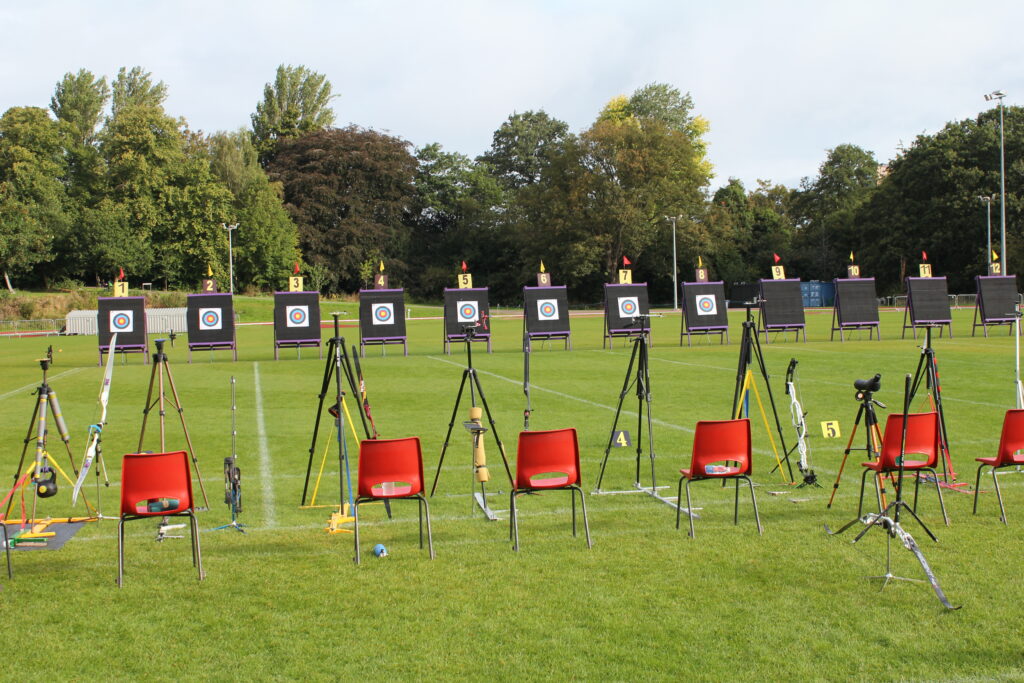
At UK Record Status Tournaments, archers may self-declare their disability but, in order for Archery GB recognised UK Records to be claimed, archers will need a valid BBS or IBSA (International Blind Sports Association) sight classification of B1, B2 or B3 and shoot with equipment as laid down in World Archery’s rules (opens in new window) in Book 3, Chapter 21. For more information on VI Archery records in general please see our records page.
To enter the BBS Indoor and Outdoor Archery Championships, or to claim a BBS Archery Section record, you must to be a British Blind Sport member (opens in new window) and have a valid up-to-date sight classification.
For more information on BBS Archery records please see our records page and the championships section below.
It will help the tournament organiser immensely if you advise them of any extra requirements, for example if you use a tactile sight; or if you have a guide dog and need a ‘tent space’ adjacent to your position on the shooting line so that the dog does not get distressed at being too far from you.
BBS Archery have a guide for spotters which explains the role and responsibilities of the spotter at a tournament.
Rounds
A ‘Round’; is an archery term for a specified number of arrows to be shot at a specified target face size at a specified distance. There may be multiple combinations of number of arrows, face sizes and distances within a ‘Round’.
A VI archer may shoot any round recognised by Archery GB (which includes ‘local rounds’). There are also a series of rounds known as the ‘Burntwood’ rounds which were created specifically, but not exclusively, for VI archers.
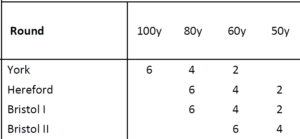
What makes these rounds different is that rather than the target physically moving closer to the archer throughout the round, the target face becomes larger instead. This means that the point being aimed at doesn’t physically move so that VI archers using tactile sights do not have to realign the tactile sights at every change of distance/face. The ‘Burntwood’ rounds are based on Archery GB (AGB) rounds but in addition there are now other rounds such as those defined for VI archers by World Archery, that do not use the ‘Burntwood’ name but follow the same principle.
The Archery GB (AGB) recognised rounds are contained in the AGB Rules of Shooting (opens in new window). Outdoor rounds are listed in Part 3, indoor rounds in Part 4 and rounds aimed specifically at VI archers (including the ‘Burntwood’ rounds) are listed in Part 11. Please note that currently the rounds listed in Part 11 do not count towards classifications or handicaps. The World Archery (WA) recognised rounds are contained in the WA Rules (opens in new window) in Book 3, Chapter 21.
BBS Archery Championships
In addition to competitions run by local clubs, counties and other archery bodies, the BBS Archery Section holds its own Indoor Championships in April and Outdoor Championships in September each year. These events are held at Lilleshall National Sports and Conferencing Centre near Newport in Shropshire.
Archers must be a BBS member to enter and to receive subsidised accommodation costs at these events. A valid and up-to-date sight classification is necessary so that archers are entered in the correct shooting category (See the BBS Archery shooting category document for more information. Entry and accommodation forms are sent to all BBS Archery members by email and must be returned by the closing date.
Archery Records
As well as shooting in tournaments for “position”, medals and trophies, archers can shoot to achieve a “Record Score” for a particular round.
International Competition
VI archery has grown from a small, pioneering community in the UK into a fully recognised international discipline, governed by formal rules and supported by World Archery. British Blind Sport (BBS) archers have played a leading role in that journey – shaping equipment standards, helping draft international regulations, and representing Great Britain at major global events.
The sport’s international story began in the late 1980s and 1990s, when UK VI archers travelled regularly to France and Belgium for demonstration and exchange competitions. These early events helped raise awareness across Europe and laid the foundations for wider global participation.
A major turning point came in 2005, when the first formal international rules for visually impaired archery were adopted by the International Blind Sports Association (IBSA). These regulations were later endorsed by the International Paralympic Committee (IPC) and subsequently incorporated into the rulebook of World Archery (WA). This marked the moment VI archery became officially recognised within mainstream international archery governance, allowing visually impaired athletes to take part in sanctioned competitions under consistent global standards.
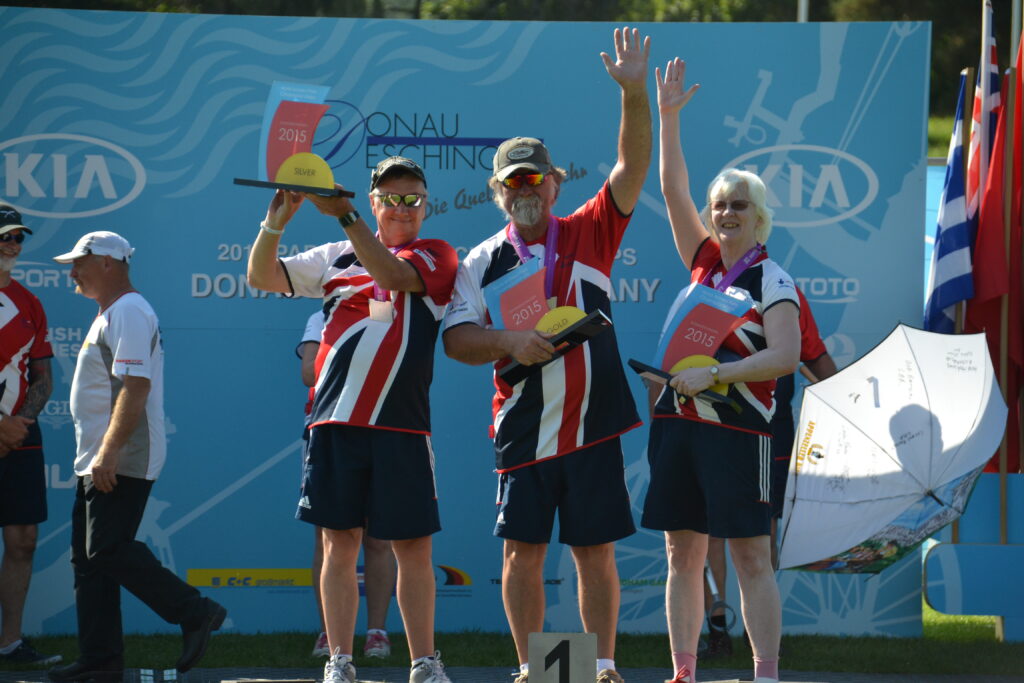
From the 2015 World Archery Para Championships in Donaueschingen, Germany, visually impaired athletes have been competing as full participants at major World and Continental events – not just in demonstration roles. British archers quickly established themselves on the international stage, achieving medal success and helping secure the long-term inclusion of VI categories at World and European Championships.
There are currently 3 main international opportunities.
World Championships
The World Archery Para Championships were first hosted in the UK in 1998 and are now held biannually. VI archers have been full participants since 2015 in Germany, and have been present in Netherlands (2019), Dubai (2022), Czech Republic (2023) and South Korea (2025).
For World Championships to take place at least 6 participants must enter.
European Championships
The European Archery Para Championships were first hosted in the Czech Republic in 2006 and are now held biannually (in between the World Championships). VI archers have been full participants since 2016 in France, and have been present in Czech Republic (2018), Italy (2022) and Italy (2024).
For a Continental Championships to take place at least 4 participants must enter.
Other Internationals
Countries host their own international competitions and invite VI archers to participate. The UK hosted the first in 2004, France hosted a VIAT in 2016 and 2017, Andorra have hosted in 2017, 2019, and 2024.
VI archers have also been present at the IBSA World Blind Games, UK (2023) and the inaugural European Para multi-sport Championships, Rottadam (2023)
For World and Continental championships, World Archery rules apply, allowing 2 classes (VI1 and VI2/3) all using tactile sights only. Where the minimum number of archers is not present to support 2 categories, tournaments reserve the right to merge the 2 categories into 1 (all wearing blackouts).
Selection for International Events
BBS Archery operates a formal selection process for both World and European Para Archery Championships. Any visually impaired archer wishing to be considered for international representation must read and meet the published selection criteria, which outline the qualification scores, performance standards, classification requirements, and conduct expectations needed for selection.
Archers are encouraged to familiarise themselves with the policy well in advance of the selection window and ensure all documentation, classification status, and performance evidence are up to date before applying.
A full copy of the current selection criteria can be found on our Selection Policy page.